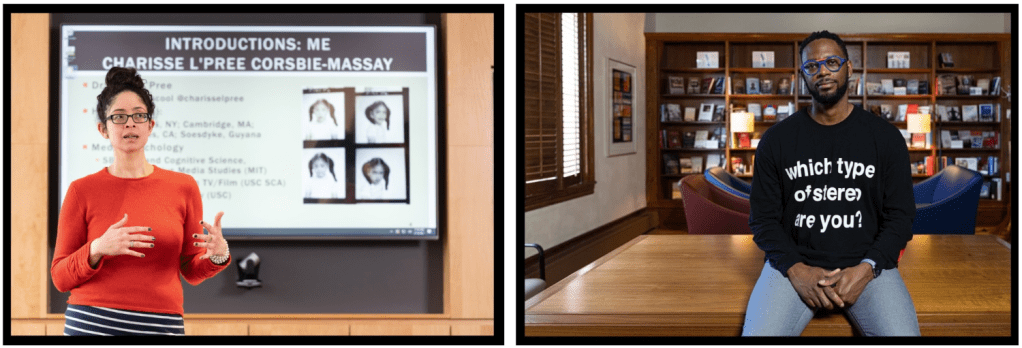
PoSH (Philosophy, Psychology, and Pedagogy of Satire and Humor) is an interdisciplinary lab group hosted by Charisse L’Pree, associate professor of communications at Syracuse University and Luvell Anderson, professor of philosophy at University of Illinois Urbana Champaign. Collectively, our whose areas of expertise include communications, psychology, philosophy, identity, humor, technologies, and popular culture.
Hear More: Can laughing at jokes and satire actually help bridge racial gaps and misunderstanding? WAER Pop Life Podcast (April 30, 2024)
Read about our projects below and meet our affiliates.
SNL101
SNL101 is a podcast for educators who want to use sketches from Saturday Night Live. Charisse and Luvell are joined weekly by “3-Time Emmy Loser” Chuck Hayward to discuss sketches from recent SNL episodes that we would use in the classroom. Check out teaser clips on YouTube and listen to full episodes on Libsyn and Apple Podcasts.
Satirizing the Racial Wealth Gap
The racial wealth gap represents centuries of discriminatory policies that baffle Americans. Satire and comedy deconstruct and demystify difficult social phenomena, but the collective confusion around the racial wealth gap makes this uniquely difficult. This – coupled with satire’s propensity for misinterpretation – means that laughing is not the same as learning. Satire must be ironic, sarcastic, or ridiculous enough to arouse attention but not so much that it overstates its case; whereas benign satire falls below this line and evokes a smirk or slight bemusement, aggressive satire is too provocative and shifts attention to thoughts about the presentation rather than its content. African American satire has a rich tradition of addressing racial and economic issues. We explore how the racial wealth gap has been represented in African American satirical television spanning almost five decades: The Jeffersons (1975), In Living Color (1990), Chappelle’s Show (2003), and Atlanta (2022) and describe when and how satire can be an effective tool of social change.
Disrupting Socioeconomic Injustice through Satire
In this study with Martina Santia, assistant professor at Montclair University, we employ an online experiment to investigate the effects of satirical content on individuals’ understanding of the absurdity of classism and socioeconomic injustice that characterize the U.S. system. Specifically, we exposed a sample of U.S. individuals to two brief articles from The Onion to address important questions regarding if and how satire is effective at changing attitudes about (and perceived self-efficacy in discussing) socioeconomic injustice. Results reveal that the original categorizations of satirical style and satirical target were not as clearly recognized by our participants. Ideological alignment was correlated with satirical appreciation but this effect was mediated by recognition of income inequality as an injustice. Furthermore, appreciation of the satire significantly predicted anti-classism confidence. The results of this work will provide essential insight into the quantitative effects of satire on social justice attitudes and perceived self-efficacy in disrupting classism by exploring a popular but under investigated satirical outlet.
Disabled Stand-Up on Social Media
Spearheaded by Emmanuel-Sathya Gray, this project explores how disabled comedians use the art of stand-up comedy to disrupt ableist discourse and discrimination via short segments of stand-up routines shared on social media. We begin with a systematic review of stand-up comedians who identify as disabled, perform in English or with comedian-generated English subtitles (i.e., not auto or AI generated), and have an Instagram profile with at least 500 followers. We analyze segments of live stand-up routines shared to social media through a content analysis to assess the frequency of topics discussed (Wen, Chia, & Hao, 2014) and a thematic analysis to further explain the process of stand-up comedy as a means of aesthetic sensemaking among self-identifying disabled artists (Braun & Clarke, 2006). This project centers disabled voices by closely listening to and analyzing the content that self-identified disabled artists have shared online to better understand how they adapt the genre of stand-up comedy to share their experiences with others, including experiences that center and those that do not center disability.
 SNL101